When “Financial Engineering” Meets a New Form of Money
How Bitcoin Treasury Companies Are Reshaping Corporate Finance and Risk
There is a simple reason many investors dismiss Bitcoin treasury companies.
They look dangerous.
Companies borrowing money to buy a volatile asset has a familiar ending in financial history. When the asset falls and the debt remains, the outcome is often forced selling, permanent losses, and sometimes collapse.
Bitcoin treasury companies are often accused of being nothing more than financial engineering. These are companies built around financial transactions rather than the production of goods or services. Their output is measured in balance sheet outcomes, not units sold.
A common concern centers on two ideas. These companies may rely on reflexivity, issuing securities to buy Bitcoin and sustaining a premium only as long as that process continues. They may also be taking on obligations against an asset whose volatility can overwhelm poorly structured liabilities.
Both concerns deserve to be taken seriously.
Yet within this group of publicly traded Bitcoin Treasury Companies, outcomes have begun to diverge. Capital B has outperformed every major Bitcoin treasury company over the past year, rising roughly 90% while Bitcoin declined and maintaining a premium to its underlying holdings when most others have lost theirs.
New forms of companies tend to emerge when existing structures are poorly suited to a new asset. These moments show how financial innovation can improve the way capital is stored, allocated, and compounded over time.
From Straight Debt to Digital Credit
The earliest Bitcoin treasury strategies relied on familiar tools. Companies issued debt or equity in fiat and used the proceeds to acquire Bitcoin. That approach allowed them to move quickly and scale positions using existing capital markets.
It also introduced a structural constraint. Debt with fixed payments does not adjust to the volatility of the asset it finances. If Bitcoin declines and the company still owes interest or principal in fiat, the balance sheet tightens and flexibility is reduced.
That dynamic has driven a shift.
New forms of securities are being designed to change the nature of the obligation. Some instruments retain fiat denomination but extend duration or remove repayment pressure. Others are denominated in Bitcoin, aligning the liability directly with the asset. Together, these structures are often described as digital credit.
Investors have validated this shift. Strategy ended 2025 as the largest equity issuer among all U.S. public companies for the second year in a row, raising $25.3 billion and accounting for roughly 8% of total U.S. equity issuance. The objective remains simple: increase Bitcoin per share over time. What is evolving is how companies finance that objective.
A Bitcoin-Native Balance Sheet
To explore this shift, I spoke with Alexandre Laizet, co-founder of Capital B and an early builder in Bitcoin-denominated corporate finance.
As Laizet describes it, the objective is to increase Bitcoin per share with structures that can sustain that process across market conditions.
Capital B represents one version of this approach. The company’s innovation was to raise capital through instruments denominated in Bitcoin to acquire Bitcoin. Its convertible bonds can be subscribed in fiat or Bitcoin, but the obligation itself is defined in Bitcoin terms.
The asset and the liability are expressed in the same unit.
That alignment changes behavior. The investor does not need to hedge currency exposure or demand compensation for holding fiat over long periods. The company does not face fixed repayment schedules that force action at unfavorable times. The time horizon extends because the liability moves with the asset.
The structure becomes more durable across cycles.
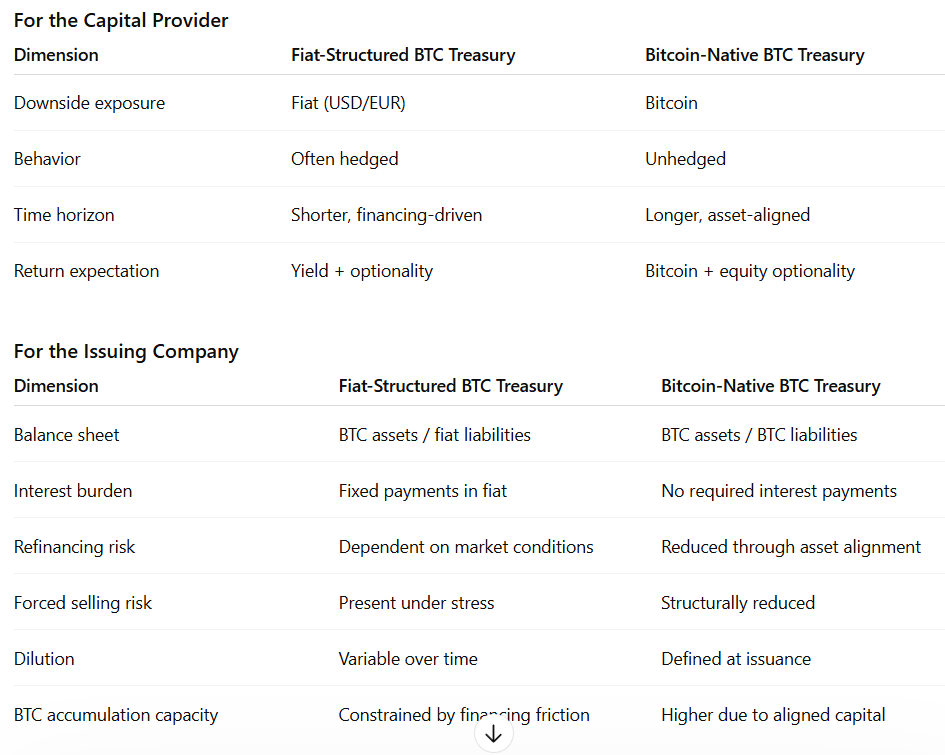
The speed of accumulation follows from these differences. In fiat structures, capital arrives with constraints that limit how aggressively it can be deployed and how consistently it can be raised. In Bitcoin-denominated structures, those constraints are reduced, allowing capital to move in the same direction as the strategy.
Capital B expanded from roughly 40 Bitcoin to more than 600 in a single operation, increasing Bitcoin per share severalfold. The structure made that possible.
A clip from our interview.
Scale and the Question of Risk
Bitcoin treasury companies now hold a meaningful share of the asset. Public companies collectively hold over 1.1 million Bitcoin, with Strategy alone holding approximately 761,000.
That concentration raises a natural question: does this structure create systemic risk?
One concern is that these companies could become forced sellers at the same time. That outcome becomes more plausible in scenarios where capital markets close, Bitcoin declines sharply, and liabilities create pressure simultaneously.
What matters is how these structures behave before reaching that point.
Bitcoin transactions primarily transfer value between participants. The cash used to buy is the same cash received by the seller. The process reallocates wealth rather than removing liquidity from the economy.
These companies also have options before forced liquidation becomes relevant. When a treasury company trades below its net asset value, it can reduce issuance, restructure liabilities, or repurchase equity. In some cases, selling a portion of Bitcoin to retire discounted shares can increase Bitcoin per share.
These are capital allocation decisions, not mechanical outcomes.
Large holders such as Strategy carry meaningful influence. Their structure matters more than their size. Liabilities are largely long-dated, with limited near-term refinancing pressure and discretionary obligations. That reduces the likelihood of forced selling even under significant price declines.
Financial structures built on top of Bitcoin can still introduce feedback loops between equity prices and financing capacity. These dynamics can increase volatility within Bitcoin-linked markets, but the effects remain concentrated within those markets rather than spreading through the broader credit system.
A New Access Point for Institutions
Bitcoin adoption began with individuals. Institutional participation followed and remains constrained by mandates, regulation, and operational complexity.
Most institutional investors can own equities and credit instruments. Many cannot own Bitcoin directly. Wrapping Bitcoin exposure inside traditional securities expands access to those investors. Bitcoin treasury companies provide that access.
They allow institutions to allocate capital to Bitcoin through familiar structures while participating in strategies that individuals cannot replicate, including issuing long-duration securities against a balance sheet.
What Is Being Created
A company built around Bitcoin behaves differently because the asset it accumulates is different. The balance sheet is used to acquire more of that asset over time, and the liabilities are structured to support that process.
This is a new form of company emerging around a new form of money.
If Bitcoin continues to mature as a monetary asset, these companies begin to resemble capital allocators operating on top of a scarce base, with the ability to issue claims against that base and redeploy capital at scale.
The skepticism remains understandable. Financial history rewards caution when new structures meet volatile assets. The effort here is to align the structure with the asset rather than force the asset into an existing system.
If that alignment holds, these companies will not be remembered as a trade. They will be remembered as an early form of a financial system built on a different foundation.
Thank you very much to our sponsors:
Truflation: BUY Truflation products/services and save 10% using code BOBDEW10. Learn about what prices are actually doing by going to https://truflation.com/marketplace/us-inflation-rate
Foundation: Protect your Bitcoin using the latest off-line technology with easy-to-use Passport. Their next product, Passport Prime will protect all passwords off-line with even better technology. https://foundation.xyz/
River Financial: If not cold storage for your Bitcoin, I’d highly recommend River for buying and holding- River is engineered to protect your Bitcoin over the long run. Use this link for discounts: https://river.com/signup?r=T7GGAF7G